Welcome to my
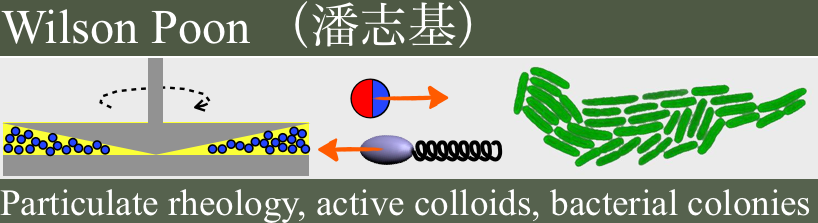
WWW home. I’m an experimentalist in soft matter and biological physics,
specialising in colloids and bacteria; I also study the relationship between
science and religion.
If you want to email me, please click here.
If you want to know what I look like (a few years ago!), click here.
My paper-mail address is:
School of Physics & Astronomy
The
Kings Buildings I
am in room 2620 of the JCMB (room 20 on corridor 6 of the 2nd
floor). If
you arrive by taxi, ask the driver to enter the KB site by ‘entrance 4’ and
take you ‘all the way round to the front of the JCMB’ (click here for campus maps). The
current (July 2012) price is approximately £7 from the train station and £20
from the airport. Buses
number 41 and 42 take you to the campus – No. 42 stops at the junction
of Mayfield Road and West Mains Road; alternate buses of route 41comes into KB
itself. The
current (July 2012) single ticket price is £1.40 – no change is given on
the bus. My work telephone number is +44 (0)131
650 5297 (exclude ‘0’ from abroad) Here you will
find: · Latest news and upcoming events ·
A
brief biography ·
My research interests in physics
(including industrial consultancy) and associated publications ·
My research interests in philosophy, history
and theology and associated
publications · Some of my sermons If you’re an industrial scientist
interested in our consultancy services, click here. If you’re interested in obtaining
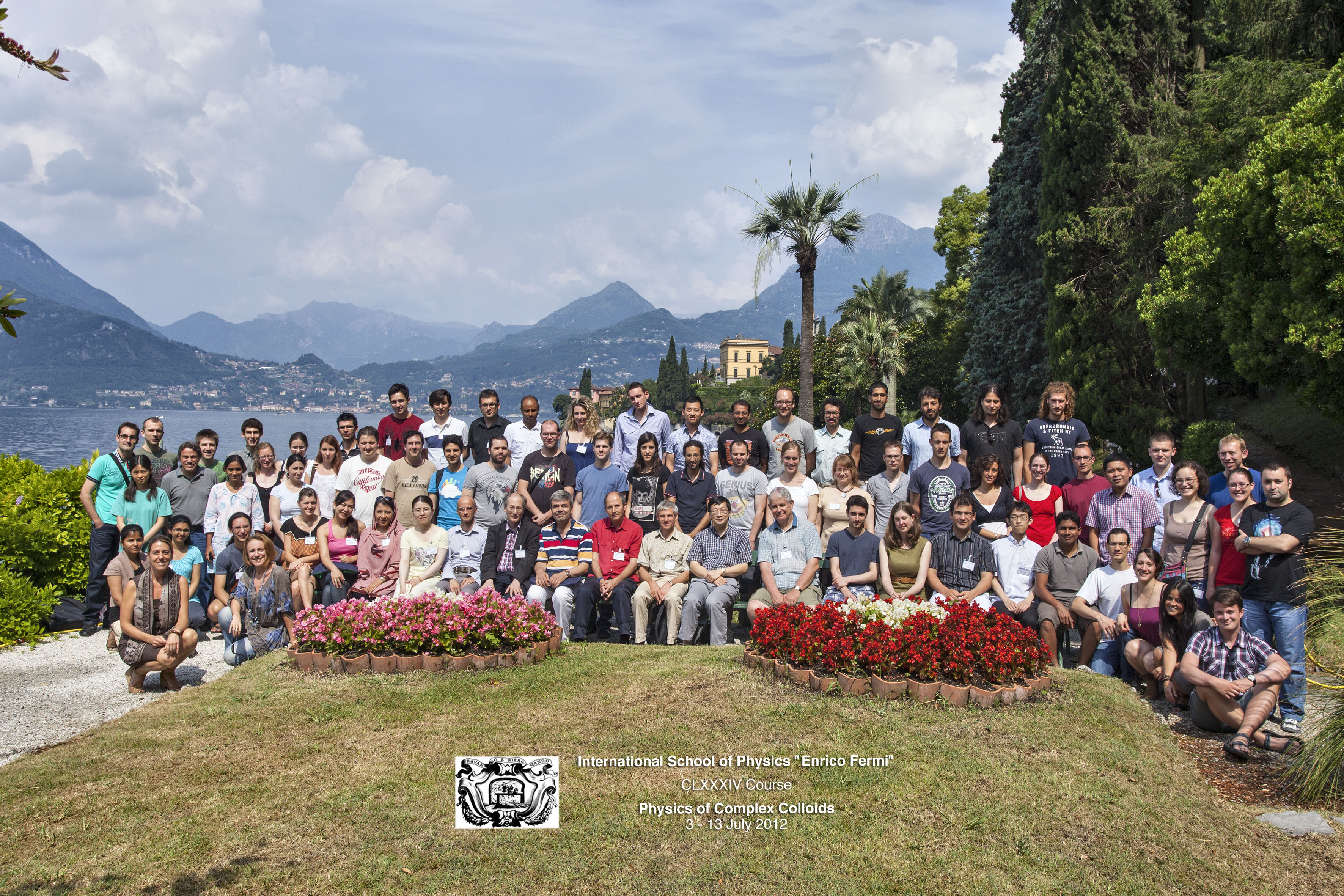
colloidal particles from us, click here. ************************************* Latest news, downloads and upcoming events Comploids summer school 2012, Varenna Jüelich Soft Matter Days, Bad Honnef,
2012 A
new MSc
in Science & Religion has been launched by the School of Divinity,
funded initially by the Templeton
Foundation. I
am involved in teaching various modules of this course. You can apply here.
[Back to Top] A very brief biography Education: 1968-1979 St. Paul's Co-educational College,
1979-1981 Rugby
School 1981-1984 Peterhouse,
Cambridge University 1984-1988 St.
John’s College and Cavendish
Laboratory, Career: 1986-1988 Research Fellow, St. Edmund’s College, 1989
Lecturer, Portsmouth
Polytechnic 1990-1997 Lecturer,
School of Physics & Astronomy, The University of Edinburgh 1997-1999 Senior Lecturer, The 1999-now Professor of Condensed Matter
Physics, The Awards and
Distinctions: 1996 Nuffield Foundation Science
Research Fellowship 2004
Fellow of the Royal Society of
Edinburgh 2007-2012 Engineering
and Physics Sciences Research Council Senior Research Fellow For
a more detailed curriculum vitae, click here. [Back
to Top] I work in soft condensed matter physics and in biological physics. My science publications are listed here – most of
the papers are linked directly to publishers’ download sites, allowing you to
get the pdf directly if your institution subscribes
to the journal. If you have difficulty, email
me and tell me which number on the list you require. Soft condensed matter physics studies liquids, called
‘complex fluids’, which contains entities with sizes intermediate between
small molecules (e.g. H2O) and macroscopic objects (e.g. the beaker
holding the liquid): colloidal suspensions, polymers and aggregates of surfactants
(soap-like molecules). These ‘mesoscopic’
entities are dominated by thermal fluctuations, or Brownian motion (see
the movie
here, courtesy of Dr. Mark Haw, and his popular book). Their presence confers a host
of fascinating (and highly applicable) properties to complex fluids. For
instance, their response to mechanical stress is intermediate between that of
the ideal solid (‘elastic’ response) and the ideal (simple) liquid (‘viscous’
response): complex fluids are ‘viscoelastic’. A good example is ‘non-drip
paint’ (a complex mixture of colloids and polymers). Under the high shear
stresses generated by a paint brush, it behaves like
a liquid; once the painting motion stops, gravity causes a small enough stress
that the paint behaves like a solid, and stays on the wall. I mainly work
on colloids - suspensions of solid
particles in liquids. My main interest is to use very well-characterised
suspensions to throw light on phenomena that are ubiquitous throughout
condensed matter physics, such as crystallisation and other phase transitions.
A very brief introduction to this research philosophy, sometimes dubbed colloids
as big atoms, is given here.
In the past I have studied equilibrium phase transitions and phase transition
kinetics. A movie here (taken by Dr.
Falk Renth) shows a colloidal suspension separating
into coexisting colloidal gas (top), liquid (middle) and crystal (bottom:
iridescence caused by Bragg reflections) phases. Next, I moved on to study
long-lived metastable states (glasses and gels) in the same suspensions,
discovering that two qualitatively distinct kinds of glassy states existed
– see the short introduction here. For a number of years
now, I have concentrated on studying how glasses and gels flow. While the
measurement of the macroscopic deformation and flow properties of such
suspensions (rheology) has a long history, the microscopic origins of the
measured flow properties have not been well understood. My group has developed
a versatile tool for imaging suspensions of both solid particles and liquid
drops (emulsions) while their rheological properties are being measured. A movie here (courtesy of Dr. I belong to
the EU Marie Curie Initial Training Network Comploids (Physics of Complex Colloids). Click to find
further details of the soft matter physics
research in the Industrial
consultancy forms a key
part of my activities. Much of soft matter physics is relevant to a wide range
of processes and products across many sectors. For further information on how
our work may be able to help solve industrial problems, see the homepage of
the Edinburgh Complex Fluids Partnership (ECFP) or contact Dr. Tiffany Wood.
Biological physics applies the
insights and techniques of physics to the study of living systems and their
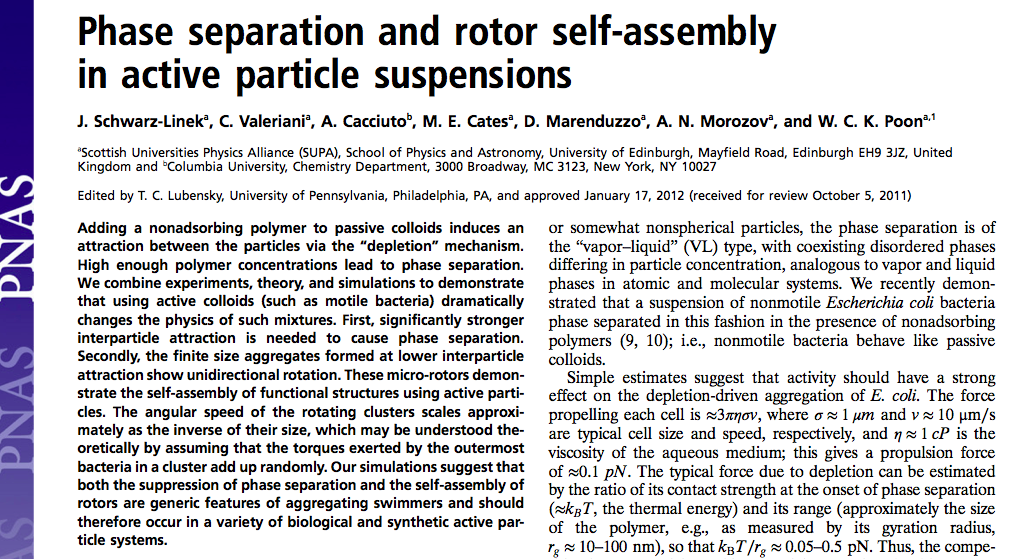
components. In the past, I used insights gained from soft matter and
statistical physics to understand the solution behaviour and self assembly of biomacromolecules, especially proteins,
DNA and lipids, e.g. how proteins crystallise or aggregate, the way DNA
stretches under flow, or how mixed lipid vesicles phase separate. Details of a
volume of NATO ASI proceedings introducing this area of research can be found here. More recently,
funded by an EPSRC senior fellowship, I have developed a programme of research
into the physics of bacteria, seeking particularly (but not
exclusively) to understand them as ‘active colloids’, focussing on their growth
and motility (here
is a movie
of swimming E. coli courtesy of Drs. Jochen Arlt
and Martin Li). The two sides of my biological physics interests come together
in the latest venture in collaboration with the National
Physical Laboratory, which is to understand the action of ‘antimicrobial
peptides’ – a new class of potential antimicrobial agents in mankind’s
long battle against infectious diseases. Click to go to
the biological physics home page to find an overview of the School’s
research in this area. [Back
to Top] Philosophy,
history and theology research My publications in these areas are listed here: in most
cases, the manuscript (though not the published) version is available. I am
interested in the history and philosophy of science, and in the relation
between science and Christian theology. Some current projects are: ·
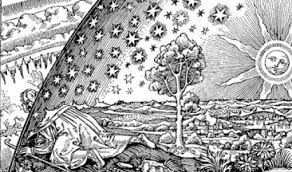
Visual representations in science – I am
interested in the pictorial representation of vectors in 19th
century natural philosophy texts. My interest was aroused after speaking at a
symposium sponsored by the Visual Arts Research Institute, Edinburgh (VARIE). · Philosophical
issues at the interface between physics and biology – This
was a collaborative project with Tom McLeish and Greg Radick
at ·
Science and religion in poetry – Many
poets have reflected on the relation between faith and (scientific) reason,
from Lucretius through John Donne to R. S. Thomas. Amazingly, this poetic
source of insight hardly features in the current (burgeoning) literature on
‘science and religion’. I am working on an anthology with comments and notes.
If you have any suggestion of what poems to include, do email
me. Two of my own poems have been published as part of a recent book chapter I wrote as a
kind of apologia pro vita sua from a scientist-believer. ·
Science and the hiddenness of God – A
scientific understanding of the world can be elaborated without any
reference to divine activities. I want to reflect on the theological
implications of this fact. An attempt at explaining this position has been
published here. (A
research seminar I gave at Cambridge exploring this topic can be seen here
provided by the Faraday Institute
for Science & Religion.) ·
A tale of the ‘three hermeneutics’ – I
believe that hermeneutics, the art of interpretation, offers a key to
understanding the relation between the arts and the sciences and between
theology and science. The tale I want to tell is that of the human attempt to
read the book of God’s words (the Bible), the book of God’s acts
(history) and the book of God’s works (creation). [Back
to Top] Sermons preached at St. Peter’s (Scottish Episcopal
Church), Lutton Place, Edinburgh ·
Giving
voice to creation – a Christian vocation in science ( [Texts:
Genesis 2:15-25, Psalm 19, Romans 8:18-25, Mark 5:25-34] ·
The
work of our hands - Harvest celebration for today
( [Texts: Deuteronomy 16:9-17, (Psalm
127), (Isaiah 28:23-29), Matthew 6:7-15] · The church in waiting – The Nunc dimmittis for
today
( [Texts: Luke
2:22-40; Galatians 4:4-7] [Texts: Jonah 3.1-5, 10; Mark 1.14-20] [Back
to Top] Last updated 11/7/12.