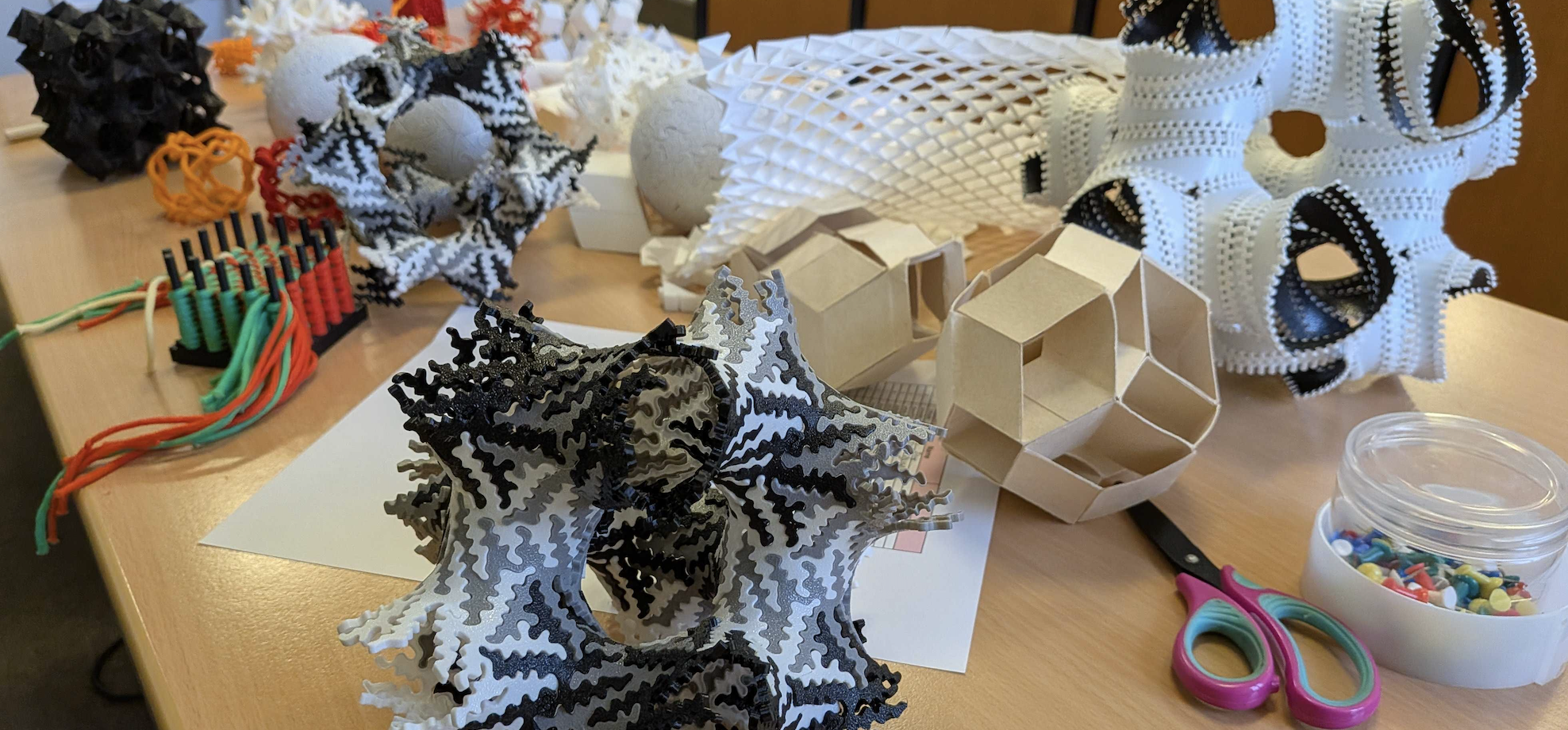
A week in Potsdam taught me that a prestigious invitation might be a bad investment and that choosing when to decline an invitation may be as important as accepting it.
I landed in Berlin on my way to Geometry, Materials and the Imagination, a five-day conference in Potsdam. Just after landing, and before taking the train to Potsdam, I squeezed an online meeting with a senior R&D leader from the biotechnology industry based in San Francisco. That meeting turned out to be the most valuable part of my trip.
We discussed the difficult journey from an interesting scientific result to a technology that works in the real world. The questions were practical and precise: How would the technology fit into existing laboratory workflows? Could it be automated? What would make a customer adopt it rather than continue using a familiar, imperfect alternative?
I entered the conversation thinking mainly about scientific performance. I left thinking much more seriously about implementation.
This did not weaken my conviction that a technology must achieve the sensitivity and precision required by the problem. But it exposed the incompleteness of that answer. Performance and usability are not alternatives. A technology that performs brilliantly but cannot be integrated into a real workflow may remain a beautiful demonstration.
I am working towards a spinout and this creates an important challenge: we must think about automation and adoption alongside the underlying science—not after it. I left the meeting with a real problem to solve.
Then I arrived at the conference
The contrast was striking.
The Potsdam meeting brought together researchers working across geometry, biology, physics, materials, art and design. The programme ranged from geometric routes to programming self-assembly, gyroid structures in butterfly wings, cell movement on curved substrates, woven and knitted fabrics, defects in liquid crystals and even the passage of an HIV capsid through a nuclear pore. I was glad to see so much pure curiosity-driven research that rang so familiar and almost intimate. However, something was not quite right.
In my keynote talk, I discussed our work on machine learning, knots and topological structures that have been discovered in living organisims or made synthetically via DNA nanotechnology (see my lab web page if interested to read more).
This is fundamental research too. So why did so much of the conference leave me uneasy?
Urgency and pace are as important as a genius discovery
The world is facing unprecedented socio-economic and technological challenges. Our lives are literally changing in front of our eyes. At this conference, instead, I was hearing concepts and ideas I had encountered at the same meeting four years earlier (and that have probably been discussed for 10-20 years before then). The wings of butterflies are interesting, yes, but are they worth spending millions of dollars, countless hours of research and people's time, enormous amounts of energy and resources, to study them across 4 continents for 20+ years?
I am realising that the pace, focus and urgency that companies apply in their day-to-day operations are not even in the same order of magnitude with the way we do research at universities.
That is a subjective judgement, and perhaps an unfair one. A blue sky research talk can contain years of genuine progress and genius discoveries -- however, I felt that most of the academic research ecosystem is unable to switch pace and tackle urgent scientific challenges.
The same type of conference might have been perfect for me 4 years ago, opening my eyes to areas of fundamental research I hadn't seen before, but it is simply no longer right for me, nor sustainable in the world we live in.
At this stage, I am torn between trying to run a research group while building a spinout around technology that must solve a significant practical problem, and eventually become something people will want to buy. Attending a broad academic conference did not help me with either priority. It cost me a week away from my work and my family. The one-hour online meeting with the senior R&D leader in biotech before the conference, by contrast, gave me a far sharper challenge, focus and sense of urgency.
That comparison forced me to confront an uncomfortable idea: a prestigious invitation can still be a poor investment.
Conferences are bets
Of course, we cannot know in advance what attending a conference will produce, the leads it will create, the new "connections between the dots", the new sparks of imagination. The best conversation may happen over coffee with someone whose name was never on the programme or someone I have never heard about. Serendipitous encounters leading to truly unforeseen breakthroughs in thinking have happened to me before at conferences. And some unplanned connections have in fact happened in Potsdam this week.
But uncertainty should be counted as part of the cost, not used to avoid making a decision.
Before accepting my next invitation, I plan to score it against four questions:
- Is the theme tightly connected to something my group or spinout *needs* right now?
- Are there at least three people attending that I *need* to meet?
- Can I gain something that I cannot obtain from papers or video calls?
- Is that gained value worth the travel, preparation, recovery and lost focus?
"A conference is a bet placed against your focus. A prestigious invitation can still be a poor investment."
How do you decide whether a conference is worth attending? What evidence do you look for before saying yes?
Looking forward to reading your thoughts.
Until the next time, yoursDavide