A recent conversation with one of my postdocs led me to write down some of my thoughts on securing a permanent position in academia.
Disclaimer - I also think that the rules of the “academic game” will be completely changed in the next 5-10 years due to AI; however at this precise moment in time, I still believe they are valid.
Some numbers to anchor this piece
Vitae's 2026 analysis of UK Graduate Outcomes data followed 2022/23 doctoral graduates to 15 months after graduation. Just over one in five—22% on average —entered a higher-education research job, such as a postdoc. ("Postdoc" is short for postdoctoral researcher and it refers to people "post PhD" who are employed typically on a fixed term research contract as part of a grant awarded to an academic member of staff, or "principal investigator".) Only 7% of these research contracts were open-ended, while the remaining 81% were on fixed-term contracts lasting more than twelve months and 11% lasting less that a year. This pattern had not changed materially since the 2018/19 cohort.
The next transition is narrower still. The University of Liverpool's UKRI-supported Prosper programme estimates that only around 10–15% of postdocs become permanent academic staff. An Imperial College London analysis gives the starker figure of 10% nationally. Quoting from the latter: "... the longer people stay in postdoctoral positions, the more they want to become academics – yet the less likely that becomes as time goes by. (...) four years seems to be a ‘breakpoint’ for postdocs, after which time the academic door effectively closes." However, not all postdocs aspire to become academics. In 2020 Nature published a survey where around one in four postodocs are unsure whether they want to become permanent academics, and I have personally met several postdocs who explicity said that, if they could, they would be happy as "forever postdocs"
Whilst we do not have access to a rigorous census that tracks cohorts, the scale is clear: roughly 25% of employed doctoral graduates enters university research, and only ~10% of postdocs ultimately secures a permanent academic position. This means, very crudely, that as you start your PhD in a cohort of 40 students, only one will secure a permanet job in academia.
Those numbers framed a difficult conversation I recently had with one of my postdocs, who was struggling to find the motivation, confidence and sense of purpose needed to take ownership of the next stage of their career.
I told them: academia is a game, and the game has rules. If you want to win, you must understand the rules, accept that these are the rules under which decisions are made, and develop a strategy. This does not mean that the rules are fair or that I approve of them. It means that pretending they do not exist will not protect you from their consequences.
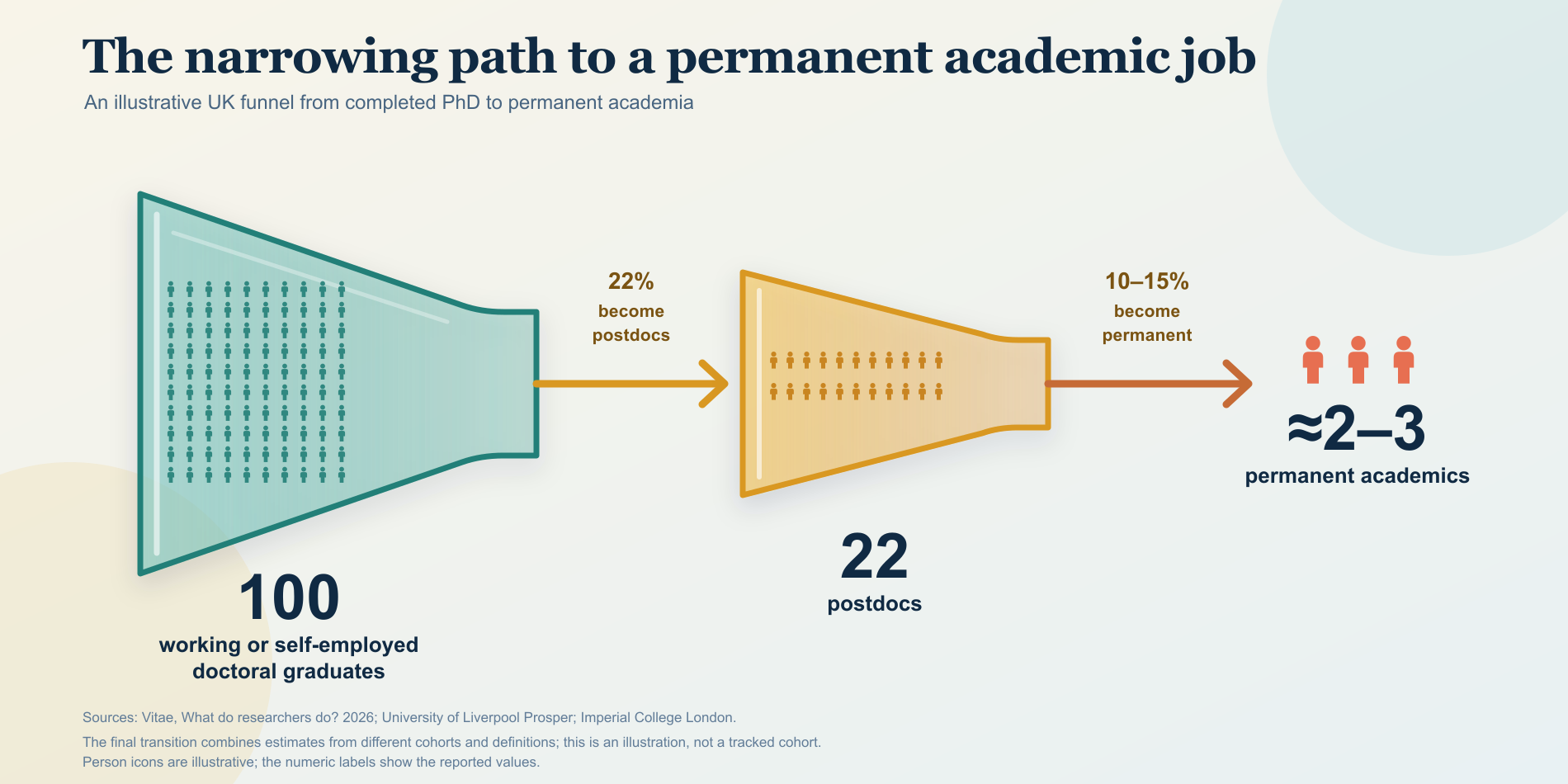
An illustrative UK academic-career funnel. The final transition combines estimates from different cohorts and definitions and should not be read as a tracked cohort.
The three rules
For many permanent academic jobs, especially at research-intensive universities, candidates must demonstrate three things:
- They can publish excellent research consistently.
- They can attract funding through grants, fellowships or other competitive schemes.
- They can deliver excellent teaching.
These requirements do not carry equal weight in every university, department or country. The balance also changes with the type of post. But for a research-focused position, the first two usually dominate—and the second often depends on the first.
A grant panel is being asked to place a bet. It wants evidence that you can identify an important question, develop a convincing plan and deliver what you promise. Publications are not the only evidence of this, but they are one of the clearest forms of evidence available. They show that you can turn an idea into a completed piece of work that survives scrutiny and enters the scientific record.
This is why “I have several interesting projects” is not the same as “I have shown that I can lead research”. Starting projects is valuable, but academia rewards completed stories. At some point, a collection of results must become a claim. The claim must be supported by evidence. The evidence must become a paper.
Many talented researchers are excellent at opening projects. Far fewer learn quickly enough how to close them. In my experience, it is the latter group who win the academic race—not necessarily because they are better researchers, but because they deliver on the bets that funding agencies place on them.
Activity is not evidence
If you do not demonstrate that you meet the criteria above, a hiring committee simply cannot appoint you. It cannot appoint potential alone; it needs evidence.
Academia contains a great deal of invisible labour: failed experiments, code that never reaches production, exploratory calculations, abandoned hypotheses, mentoring, troubleshooting and the emotional work of keeping a collaboration alive. All of this can be necessary. Some of it is deeply valuable. Yet a selection panel, working through dozens or hundreds of applications, sees only what has become legible from the outside.
Papers, grants and teaching experience are legible.
That can feel reductive because it is reductive. A CV compresses years of effort into a few lines. But if you want an academic job, you must understand what evidence the people making the decision actually use.
Working hard is not itself one of the criteria. Being busy is not one of the criteria. Having many promising ideas is not one of the criteria. The game rewards the ability to convert effort, judgment and ideas into visible outcomes.
Accepting the rules does not mean embodying them
Some people will dislike the metaphor of academia as a game. However, those same people may agree that academia is a system with participants, incentives, constraints, limited resources and criteria for "winning", where winning is defined here as securing a permanent position. Academic hiring, grant competitions, publishing and promotion are all systems with well-defined rules.
One of the biggest dangers in this process is confusing the game's score with your worth as a person.
A rejected fellowship does not prove that you are a bad scientist; it means that your application was not selected in that round. A rejected paper does not mean that your ideas are unimportant. The argument may have been unclear, the evidence incomplete, the fit unsuitable or the reviewers simply unconvinced. Treating rejection as a judgment of your personal worth is one of the most damaging things a researcher can do. Accepting that the system has rules means accepting them operationally: seeing clearly how it works, interpreting what is happening around you and charting a path towards where you want to go.
You may decide that the game is not worth playing. That is a legitimate decision, not a defeat. The sacrifices may be too large, the uncertainty too prolonged or the available jobs incompatible with the life you want. I think every aspiring academic should ask: What am I willing to trade for this career—and what am I not willing to lose?
But if you decide to play, then play the game that exists—not the one you wish existed.
Strategy is part of the job
Once you accept that the rules exist, the next steps are straightforward to describe but difficult to put into practice:
- Understand the rules and identify your priority—the area in which evidence is lacking.
- Build a strategy for producing the evidence the game requires.
- Test your strategy, learn from failure, adapt and test again.
For one person, the immediate priority may be finishing a paper rather than opening another project. For another, it may be turning a body of published work into a fellowship proposal. Someone else may need teaching experience, a stronger collaboration network or a clearer scientific identity.
The strategy must be specific to the gaps in your own evidence.
It also requires resilience. Everyone can tell you that successful grants often follow many rejected applications. However, rejections can be opportunities: to clarify your thesis and your science, improve how you present your ideas and prioritise certain questions over others. For me, the situation changed when I began learning from the pattern and reconsidered my attitude towards rejection. Eventually, I took a broader view of my scientific interests and articulated a genuinely independent scientific identity.
Trial and error is not a detour from an academic career. It is a way to test your ideas and learn about yourself and your resilience.
Not even the best supervisor in the world can—or should—supply the drive and motivation required to keep playing. We can explain the rules and the risks, help with strategy, create opportunities and offer honest feedback. But the effort to turn opportunity into evidence must eventually come from the person whose name is on the application.
That was the message I was trying to give my postdoc. It was not “you are on your own”. It was: I can help you learn the rules of the game, but I cannot play the game for you.
What is the role of the principal investigator (PI)?
The most difficult part of my conversation with the postdoc was about responsibility.
When I encourage a researcher to take ownership of their project, I am not telling them to “figure everything out alone”. Supervision matters. Mentoring matters. A principal investigator should provide feedback, challenge weak reasoning, help set priorities and create the conditions in which people can grow. A PI should be a catalyst for that growth.
But the PI cannot become independent on someone else's behalf. Researchers need to demonstrate their own independence. I cannot write every paper for a postdoc and then tell a hiring committee that the postdoc has demonstrated intellectual leadership. If I build the argument, decide the claim, select the evidence and drive the paper to completion, I may help produce a publication—but I have not helped that person prove that they can do those things without me.
At some stage, I need a researcher to come to me with their proposed story: this is the question, this is the claim, this is the evidence, this is what is missing, and this is why the result matters.
We can then discuss the story and how to present it. We can take the argument apart and rebuild it. We can agree on the key claim and how to support it. But the drive and main intellectual effort must come from the researcher.
This is also why academic work can feel lonely. I pursued this career because I wanted to make discoveries and design and complete research projects. Leading a group is different. You must pass on skills that you spent years developing, while accepting that you may no longer use them yourself on a day-to-day basis.
The role of luck
Luck also came up in the conversation with my postdoc, as they said "it's easy for you to believe these rules, because you have been lucky enough in your career to win grants and secure a position".
They were right. I have been extremely lucky. Luck matters in academic careers; you've got to be at the right place, at the right time, with the right idea. But opportunity rarely appears from nowhere. What looks like a lucky break from the outside may rest on years of invisible work: developing skills, building a network of collaborators and people that trust you and your science, building reputation within a scientific community, learning from rejections and spending countless hours writing fellowship applications that may never be funded. This work does not manufacture luck, but it changes the conditions in which luck operates. Because I wrote many fellowship applications and learned how to receive feedback and rejections, I naturally got better at them. Was it then luck that I eventually secured a research fellowship? Maybe. Maybe not.
At the same time, no amount of work guarantees an opportunity, and opportunities are not distributed equally. Chance still matters. But an opportunity is not yet an outcome. A funded fellowship, a contract extension or an introduction to a new collaborator creates a possibility; it does not transform that possibility into success.
This is a key point that it is difficult to make without sounding like a manager. A PI can help create opportunities by securing funding, extending a contract, making introductions and offering honest feedback. But the researcher must ultimately do the research; they have to recognise the opportunities, the luck, take ownership of the projects and convert them into evidence of what they can do.
Luck and invisible work can influence the cards you are dealt, but neither the cards nor the PI can play the game for you. You've got to take those cards, and run with them.
I'd be really grateful to receive comments from both academics or PhD/postocs on this piece and keen to hear other people's opinion on this delicate topic.
Until the next time,
Davide