AI will bring an end to universities as we know them. I believe they are not ready to lead us into this new era.
Today, I had a brief conversation with a very bright home-educated nine-year-old girl. She asked me, with some concern, “How will AI affect the way children learn?” The fact that she asked me this question is indicative of widespread concern and anxiety about how AI will change both education and research. I personally share that concern, and I think universities should lead—rather than be led—into this new era of education.
Last week was Freshers’ Week at the University of Edinburgh. Thousands of students arrived in the city, met their classmates and began discovering what university life might mean for them. Despite the excitement, I could sense a lot of anxiety and uncertainty, sharpened by recent news that Edinburgh staff had just announced 25 days of strike action across five weeks, responding to a controversial plan to save £140 million by cutting 1,800 jobs.
The tension is, literally, in the air, and I am wondering whether this might be one of our last Freshers’ Weeks. It is clear that universities’ business models are no longer sustainable. I wonder whether we are approaching the end of the university as we know it: a place where students come to attend lectures, accumulate knowledge, sit examinations and leave with a credential that is supposed to make them employable, often in exchange for a large amount of money.
That bargain was already under strain and now AI will break it.
What exactly are students buying?
For a student from England starting in 2026–27, the maximum tuition-fee loan is £9,790 per year. That is £29,370 for a three-year degree, before accommodation, food, etc. International students can pay much more. What is the student buying for that money?
Part of the answer is knowledge. But knowledge is becoming abundant and democratised by AI. Today, a few tokens can bring you all the knowledge accumulated over hundreds of years of universities. A personalised AI agent can patiently explain the same idea ten different ways, adjust to a learner’s pace and remain available at two in the morning. The technology is imperfect, sometimes confidently wrong and not yet a substitute for every teacher. But it is improving at an impressive pace.
It is not difficult to imagine reputable institutions turning their courses into personalised teaching agents. MIT OpenCourseWare already makes material from virtually all MIT courses freely available. Simply add an adaptive interface that questions the student, detects gaps in understanding and constructs a path through that material, and the economics of content delivery begin to look very different. Imagine an AI assistant who can patiently teach you any course on the MIT programme in an interactive way that best suits your specific learning pattern.
Why should somebody pay tens of thousands of pounds merely to passively receive information in a lecture theatre by a stressed lecturer who also has to apply for grants and do admin to avoid being fired?
Physical universities still offer the personal experience: friendships, parties, societies, independence, etc. Students want laboratories, studios, clinics, libraries, mentors and networks. These things matter. I firmly believe that the interpersonal component is the one that AI will never be able to reproduce. But we should be honest. A coming-of-age experience is not the same product as an education, and neither is automatically worth any price a university chooses to charge.
Prestige is not a business model
For years, many UK universities have aimed to attract more and more international students who pay higher fees. However, the Office for Students’ 2025 financial-sustainability report describes a sector already under serious financial pressure. It is extremely short-sighted to assume that students around the world will continue to pay a premium indefinitely because a degree carries the name of a prestigious British university. It is a belief that, in my opinion, carries an old imperialistic confidence which is damaging the sector.
The scientific world has already changed. China has now taken the lead in the Nature Index country tables for research output in selected high-quality journals. While research strength is not identical to teaching quality, the two strongly correlate; in fact, this relationship is emphasised by the UK’s Russell Group to attract students. But the idea that the best science and education naturally flow from Britain to the rest of the world is obsolete.
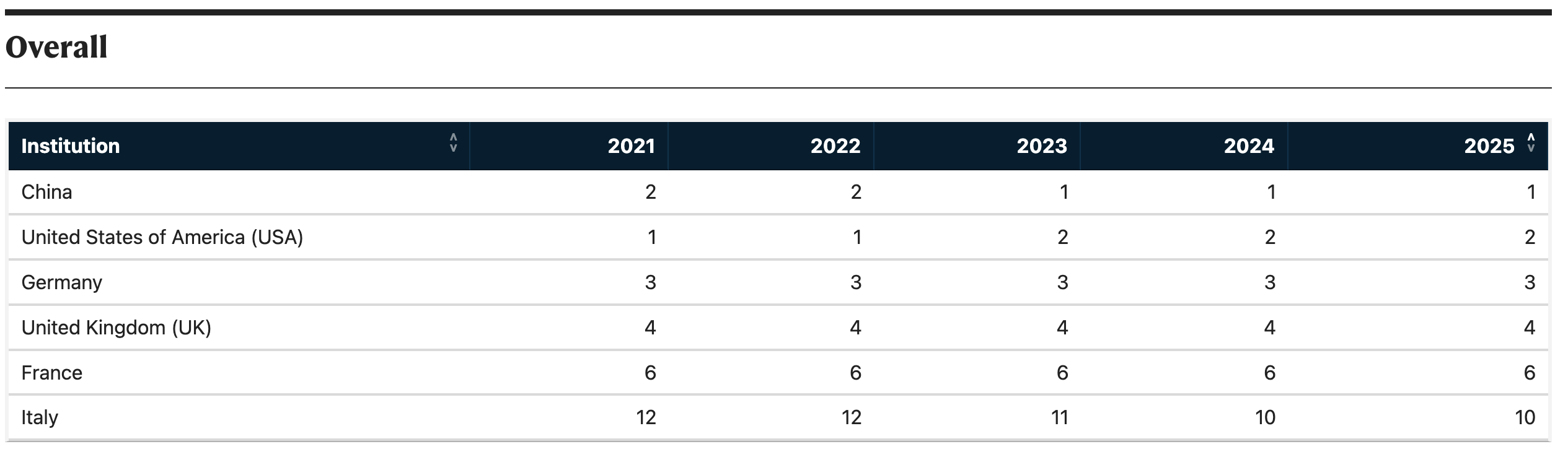
If students can learn from excellent institutions in their own countries—or buy a personalised course from a globally recognised provider—prestige alone will not protect us. What and how they learn will be more important than where they learned it.
We must stop asking “Did they use AI?”
That conversation with the nine-year-old crystallised a thought: in an era when a machine has instant, intelligible access to hundreds of years of accumulated knowledge, what is the purpose of education? We cannot compete with AI in terms of accumulated knowledge, in the same way that we cannot compete with the speed of computers performing complex sums and multiplications.
The valuable abilities will be, for example, critical thinking, recognising a good question from a bad one, spotting a shallow or incorrect answer, being able to test the validity of an answer, connecting ideas and deciding priorities.
The issue is not whether to let students use AI; it is HOW we make students use it.
Stanford’s SCALE initiative conducted a large field study in secondary-school mathematics: “Generative AI Can Harm Learning”. Students who were given unrestricted access to a GPT-based assistant performed better during homework assessment but worse when that assistance was removed. However, a more carefully designed tutor, which gave hints and guarded against simply supplying answers, largely avoided that loss of learning.
AI must become a research partner and a tool that students learn to interrogate constructively. That means learning how to check its claims, how to find its blind spots and how to retain responsibility for the final judgment. Personalised teaching agents are coming anyway; we may as well build them well—and embed them in an education based on mentorship, projects, collaboration and discovery.
Through this exercise, students have the opportunity to learn what Freeman Dyson called a bird’s way of thinking: taking broad views and connecting concepts from diverse fields, in contrast with the frog’s close attention to detail and its tendency to solve problems one at a time. For Dyson, science needs both birds and frogs. However, frogs are being replaced by AI’s extraordinary ability to write thousands of lines of code or detailed mathematical proofs in minutes with barely any mistakes.
NVIDIA CEO Jensen Huang said that AI will not replace thinking, but rather will help people think through problems. His broader point is that asking good questions remains an intellectually demanding human task.
Stop rewarding repetition
If critical thought and good questions are the skills we need, our curricula and assessments should demonstrate that we value them.
Does it still make sense to organise a degree around how much material we can cover in lectures? Does a closed-book examination tell us what we need to know about a graduate entering an AI-saturated workplace?
In my experience, students often come alive during the research projects at the end of an honours BSc or MSc, in which they are often asked to investigate something genuinely new. To make progress, they must first understand how to ask a good question about the subject and then work out how they might answer it. Often, the success of such projects relies not on finding the right answer, but on finding the right question.
I believe that this could be the future of education: teaching students how to think and how to ask good questions.
In practice, this means a more project-based, exploratory and responsibility-driven curriculum that puts students in charge of their own learning. Students should feel encouraged to deep dive into a topic and construct their own way of understanding some aspect of the world. AI will play a role; however, it is the student who will ultimately frame and decide the problem to pursue, evaluate the evidence and own the reasoning.
This could enrich academic life too. Instead of delivering the same lecture year after year, academics could build dynamic teaching modules around live problems. Key concepts would become tools for understanding and discovery rather than material to be repeated in an exam.
Lead the change—or be led
The threat is not confined to teaching. If fewer students are willing to pay for courses that do not improve their employment prospects, tuition income will fall. Universities will cut staff, as is already happening around the UK. Because most academics teach and conduct research at the same time, lost teaching income will mean lost research capacity and more pressure to secure research grants, which are also being cut.
Universities need to get their act together now. They should ask themselves how to become the leaders of the AI revolution in education and research, rather than waiting for big tech companies to tell us what we are allowed or not allowed to do, or how to use their models.
Why can’t UK universities work with government to build sovereign public AI infrastructure and models? Such an initiative could strengthen the UK’s technological sovereignty, reducing our dependence on privately controlled systems for strategically important research, education and public services. The issue is not hypothetical. NHS England awarded a Palantir-led consortium a contract worth up to £330 million to provide its Federated Data Platform. Palantir is a US data-analytics company with extensive defence and intelligence work; doctors, campaigners and privacy experts have raised serious concerns about transparency, patient consent and entrusting sensitive public infrastructure to such a company. All this is because the UK is lagging behind on AI.
Universities still have (surprisingly, and perhaps not for long) extraordinary concentrations of knowledge and talent. With serious government support, they could lead this transformation in the public interest rather than waiting for private companies to determine what education becomes.
But they must move quickly. Universities are institutions designed to endure, and often to change slowly. That is usually a strength. At this moment, it may be fatal. A five-year lag is not an adaptation strategy when the technology changes every few months.
AI is an existential threat to our present education and research system. It is also an opportunity to remember what education was supposed to be: not the transfer of answers from one generation to the next, but the cultivation of people capable of asking better questions.
Until the next time,
Davide