Two‑Dimensional Superconductors
Superconductivity was among the properties of graphene, the 2D wonder material opening the way for superconducting device and quantum memory qubits. Nowadays, other 2D materials reach much higher superconducting temperatures. 2D materials (Janus chalcogenides, boride monolayers, MXenes) can host phonon‑mediated superconductivity at remarkable temperatures for atomically thin systems. They are grown experimentally with chemical vapour deposition, but this is challenging and calculations are the best way to determine what might be worth making.
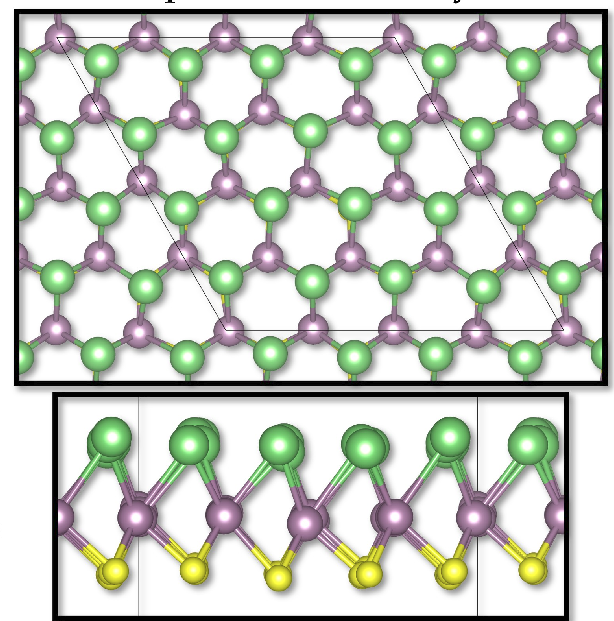
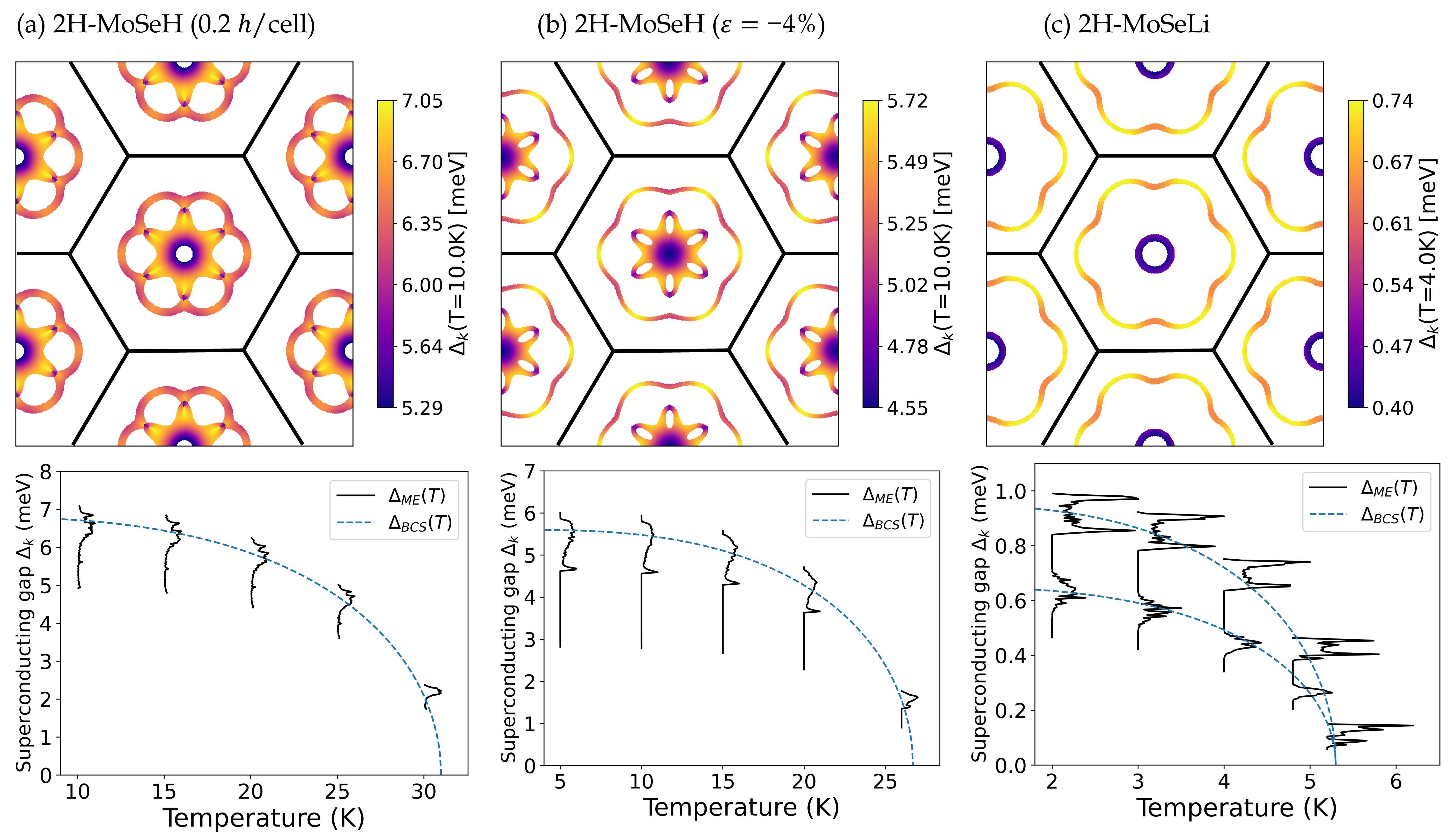
We considered many permutations, across published and arXiV papers
WSeH and WSH are predicted to have Tc=9.23K and 10.52K
Permutations of (Ti,Zr, Hf)(S,Se,Te)H have predicted Tc in the 20-30K range. They also have magnetic states, which may be metallic, half-metallic or semiconduting. We predict that magentism will be preferred to superconductivity in all cases except HfSH and HfSeH.
Hydrogenated borides (Sc,Y,V,Nb)B2Hx are variants of the BCS
superconductor MgB2. The calculations show Tc 69 K and 83 K for Nb2B2H4 and
V2B2H4, respectively.
References